

The single most common question we get from new owners is the same: how much will my apartment make if I hand it to you? It deserves a real answer. The number for a professionally managed two-bedroom in Riyadh in 2026, based on our trailing twelve months, sits between 26,000 and 42,000 SAR per month gross, with a net to the owner of roughly 18,000 to 30,000 SAR. That range is wide for a reason, and the reasons are what this piece is about.
The wider hospitality market is one input, but the difference between a unit at the top of that range and one at the bottom is rarely demand. It is operations, pricing, presentation, and how the unit’s calendar is managed across platforms. Below is what we actually see in the data from our mature units, plus a quick model you can run on your own apartment in ten minutes.
The headline number, and what it doesn't tell you
Take Away
A monthly figure quoted in isolation is the wrong unit of measurement. Look at trailing twelve months, peer-group median, and the spread between top and bottom quartile.
ADR, occupancy, RevPAR: what each one actually means for your unit
Three numbers do most of the work in hospitality analytics. They are easy to confuse and the relationships between them matter. Briefly, in plain language:
Average Daily Rate (ADR)
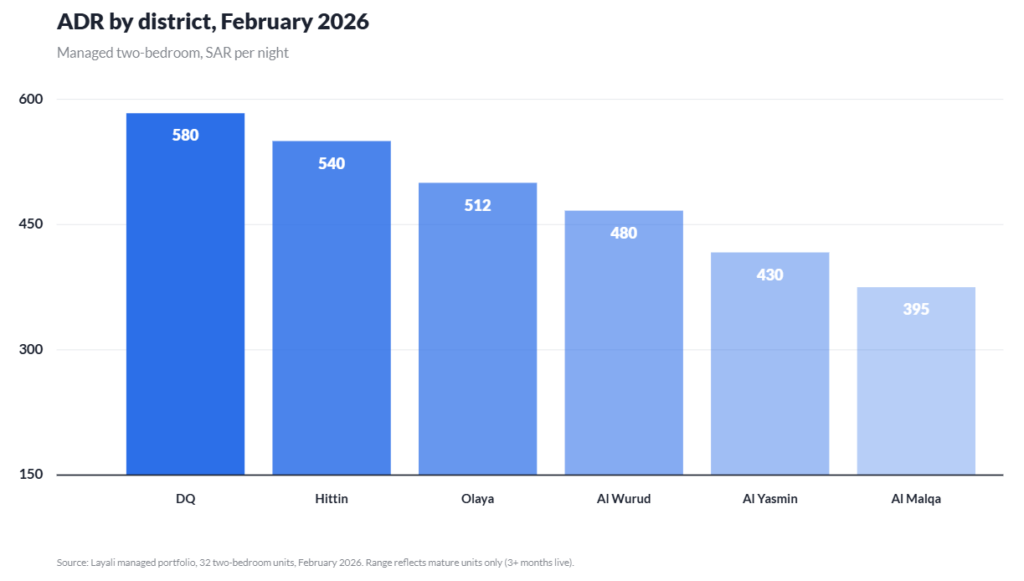
The average price per booked night, after platform discounts and length-of-stay rules. A managed two-bedroom in Olaya in February 2026 sat at an ADR of 512 SAR. ADR is mostly a function of district, unit size, finish quality, listing photography, and how aggressively the calendar is priced day-by-day.
Occupancy
The percentage of available nights that were actually sold. A 91 percent occupancy means the unit was booked 27.3 of 30 nights. Occupancy is mostly a function of pricing, listing quality, review scores, and minimum-stay rules. The cheapest way to lift it is usually to remove a needless 3-night minimum.
RevPAR (Revenue per Available Room-Night)
ADR multiplied by occupancy, expressed per available night. RevPAR is the one number that tells you whether your unit is a strong performer, because it captures price and demand together. The two-bedroom in our portfolio average ran a RevPAR of 466 SAR in February (512 SAR ADR × 91 percent occupancy).
Tip
When comparing two listings or two managers, ask for trailing-twelve-month RevPAR, not a single month and not ADR in isolation. RevPAR is harder to flatter with cherry-picking.
Where the costs go (and why the net is often higher than self-managed)
| Self-managed (2024) | Managed (2025) | |
|---|---|---|
| Gross revenue | 262,000 | 408,000 |
| Average occupancy | 68% | 91% |
| ADR (annual avg.) | 432 | 498 |
| Platform fees | (39,300) | (61,200) |
| Cleaning & turnover | (28,400) | (38,800) |
| Supplies & restock | (8,200) | (11,000) |
| Management fee (18%) | 0 | (73,440) |
| Photography, listing | (2,400) | 0 |
| Net to owner | 183,700 | 223,560 |
How to estimate your own unit in 10 minutes
You do not need a spreadsheet to get a defensible estimate. The model below uses three inputs you already know, plus one external number you can look up.
- Base ADR for your district and unit size. Pull the district median from the chart above, or look at three to five comparable AlrBnb listings in your building / street.
- Realistic occupancy. A mature managed unit in Riyadh sits at 88 to 94 percent. A new listing in months 1 to 3 sits at 55 to 70 percent. Use 80 percent for a first-year estimate.
- Adjustment factors. Add 8 percent if the unit is photographed professionally. Subtract 6 percent if it requires a minimum stay over 2 nights. Add 5 percent if it has dedicated parking.
- Cost stack. Subtract roughly 14 percent for platform fees, 9 percent for cleaning and supplies, and your manager’s fee.
The arithmetic, for a two-bedroom in Olaya at the portfolio median: 512 SAR × 30 nights × 0.85 occupancy = 13,056 SAR gross per month. Apply the cost stack and an 18 percent management fee, and net to owner sits around 8,400 SAR per month, or roughly 100,800 SAR per year. That is the conservative case. The same unit at 91 percent occupancy and a 540 SAR ADR (which we routinely see by month 6) nets closer to 145,000 SAR.
If you want a tighter number for your specific unit, including district, finish, and access details, the in-page estimator below will produce one in about ninety seconds. We will follow up with a fuller pricing model after a short call.